Q: I already have hearing aids, but I still can't understand what people are saying. Why?
A: This is the most common complaint among seniors. After years of hearing loss, the brain’s "understanding center" becomes weak. Hearing aids bring the sound in, but your brain doesn't know what to do with it. HearGym acts as a companion for hearing aids, providing the "physical therapy" your brain needs to turn those amplified sounds back into meaningful words.
Q: I don’t have "hearing loss" yet. Is this for me?
A: Yes. We call this the "Sub-clinical Gap." Many adults pass standard hearing tests but feel they have to "strain" to listen. HearGym uses the Listening Effort Index (LEI) to detect this strain before it becomes a disability. It’s "Pre-hab" for your brain—keeping your cognitive processing sharp so you stay engaged in your professional and social life longer.
Q: How does "Cognitive Training" actually feel?
A: It feels like a personalized brain workout. Through our multimodal sensors (tracking your brainwaves and behavior indicators), the system knows exactly when your brain is working too hard. It adjusts the difficulty in real-time to trigger neuroplasticity—literally rewiring your brain to process sound more efficiently.
Q: What is the "Unfair Advantage" of HearGym’s technology?
A: We own the Dual Closed-loop Architecture. Unlike generic "brain game" apps, HearGym integrates real-time physiological data (EEG + Pupil + HRV). We aren't guessing if the user is focused; we are measuring it. This allows for OPB (Optimal Plasticity Band), a system that adapts at the speed of thought. Our strong patent portfolio protects this hardware-software integration, making it extremely difficult for competitors to replicate.
Q: What is the value of the "Proprietary Dataset"?
A: Data is the new oil. We are currently the only entity collecting large-scale, synchronized data on how the human brain struggles with auditory signals in real-world environments. This dataset is a goldmine for future AI development in MedTech, Longevity, and even consumer electronics (like "Smart" earbuds), creating a massive valuation moat.
Q: Why is the "Consumer" positioning better than "Medical"?
A: Speed to market. By positioning as Consumer Cognitive Training, we bypass the 5-7 year clinical trial cycles required for "therapy" devices while still delivering science-backed results. This allows us to scale globally, capture the "Aging Well" market immediately, and establish HearGym as the household name for auditory fitness.
Q: What is the "Listening Effort Index" (LEI) and why is it a game-changer?
A: Before HearGym, "listening effort" was invisible and subjective. LEI makes it quantifiable. For the user, it’s a progress bar for their brain health. For the clinician or investor, it is a standardized metric that proves the intervention is working. It turns "I think I hear better" into "My LEI score improved by 30%, and my cognitive load is down."
Q: Does this prevent Dementia?
A: While we do not claim to treat medical conditions, the Lancet Commission has identified mid-life hearing strain as the number one preventable risk factor for dementia. By reducing the cognitive load required to listen, HearGym aims to keep the brain active, healthy, and connected, potentially delaying the onset of cognitive decline.
Q: Why is now the right time for this technology?
A: We are seeing a "perfect convergence":
Mainstream Acceptance: AirPods have made audio enhancement normal.
Tech Growth: Consumer neurotech is rising (e.g., Muse).
The Crisis: Global noise levels and "remote work" cognitive load have skyrocketed.
AI Capability: AI now allows for the real-time personalization required to train the brain.
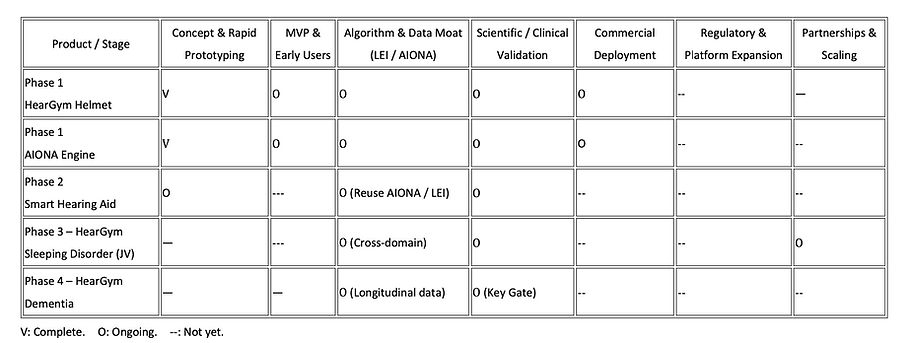
Q: What is your product pipeline? and their progress?
A:Our initial launch includes the HearGym Helmet and the AIONA engine. Building on this foundation, we will expand into smart hearing aids and additional products targeting sleep disorders and dementia. The product development pipeline is outlined below.